
Outsourced medical billing companies in UAE typically charge between 4% and 9% of monthly collections (or a flat per-claim fee), creating an ongoing operational expense that scales upward alongside clinic revenue. In-house billing replaces variable agency fees with fixed payroll, benefits, and specialized training costs, regardless of collection volume. However, a third alternative exists: EMR software with native DHPO and insurance claim automation. By handling automated coding validation, eligibility checks, and claim scrubbing internally, clinics eliminate heavy manual overhead while avoiding percentage-based third-party fees.
Table of Contents
The Question Most Clinics Frame Wrong
When a practice manager or clinic owner in Dubai, Abu Dhabi, or Sharjah experiences a surge in insurance claim rejections, the immediate instinct is to look for an operational fix. In most strategic discussions, that conversation quickly reduces to a strict binary choice:
- Choice A: Hire dedicated medical billing companies in UAE to take over the entire revenue cycle management (RCM) process.
- Choice B: Hire additional in-house medical billers and coders to scrub, submit, and chase unpaid claims manually.
This framing is fundamentally incomplete. It evaluates who performs the manual labor while ignoring the underlying digital infrastructure that dictates how much labor is required in the first place.
When evaluating medical billing companies in UAE versus internal teams as purely a staffing decision, clinics overlook how modern electronic medical record (EMR) platforms interact directly with regional portals like the Dubai Health Postcard / Dubai Health Authority (DHPO/eClaimLink) framework, Abu Dhabi’s Shafafiya system, and the Ministry of Health and Prevention’s Riayati portal.
Choosing between an outsourced agency and an expanded internal team without evaluating your EMR’s native automation capabilities often forces clinics into paying twice—either through high percentage-of-collection fees or unnecessary administrative overhead. Understanding the real financial impact of partnering with medical billing companies in UAE requires analyzing all three operational models: outsourced RCM agencies, traditional in-house billing teams, and EMR-native automated billing workflows.
What Outsourced Medical Billing Companies in UAE Actually Charge
Contracting with medical billing companies in UAE transfers the administrative burden of claims processing, denial management, and Third-Party Administrator (TPA) follow-ups to an external service provider. While this model promises to relieve internal staff of tedious paperwork, its long-term cost dynamics deserve careful examination.
Dominant Pricing Models in Medical Billing
Across the local market, medical billing companies in UAE generally structure their contracts under two primary pricing models:
- Percentage of Collections: The billing agency receives a predetermined percentage of all revenue successfully collected from insurance payors.
- Flat Fee Per Claim: The agency charges a fixed fee for every claim submitted, regardless of the underlying claim value or reimbursement success.
Important Benchmark Note: Percentage figures and fee structures cited in general industry literature frequently reference global benchmarks, where outsourced rates typically span 4% to 9% of net collections. These figures serve as general industry reference points rather than verified, standardized UAE market rates. Practice managers should request detailed proposals from medical billing companies in UAE tailored to regional TPA and health authority rules before committing to external RCM contracts.
The Scaling Cost Problem: An Illustrative Calculation
To illustrate how a percentage-of-collections agreement functions over time, consider a growing multi-specialty clinic in Dubai generating AED 100,000 per month in insurance reimbursements.
If the clinic contracts with medical billing companies in UAE at a benchmark rate of 6% of collections, the monthly service fee equals AED 6,000. On an annual basis, the clinic pays AED 72,000 for billing management alone.
Now consider what happens as the clinic expands its patient volume:
- Month 1 Collection: AED 100,000 → Fee paid: AED 6,000
- Month 12 Collection: AED 250,000 → Fee paid: AED 15,000
- Annual Billing Cost at Scale: AED 180,000/year
Because percentage fees scale linearly with revenue, the clinic pays significantly more as its clinical volume grows even though the underlying administrative effort required to process standard eClaims through DHPO does not scale at the same rate.
OUTSOURCED BILLING COST SCALING EXAMPLE
Monthly Insurance Collections: AED 100,000 –> Fee (6%): AED 6,000
Monthly Insurance Collections: AED 200,000 –> Fee (6%): AED 12,000
Monthly Insurance Collections: AED 300,000 –> Fee (6%): AED 18,000
Result: Agency fees increase linearly with revenue growth, regardless
of whether clinical work became structurally harder to bill.
Hidden Costs and Contractual Fine Print
Beyond the primary percentage fee, contracts from medical billing companies in UAE frequently contain auxiliary line items that compound the total cost to collect:
- Onboarding & Setup Fees: Upfront capital charges required to configure clearinghouse routes and integrate patient databases with external RCM software.
- Minimum Monthly Retainers: Clauses stipulating a minimum floor fee (e.g., AED 3,000/month), ensuring the agency receives payment even during slow seasonal months or holiday periods.
- Clearinghouse & Transaction Fees: Separate charges passed back to the clinic for eClaimLink or gateway transmission costs.
- Uncollected Claims Liability: Most agreements with medical billing companies in UAE calculate fees against gross collections, meaning the clinic pays full commissions on easy claims while difficult, delayed rejections may receive minimal agency follow-up if the effort exceeds the margin.
What In-House Billing Actually Costs
Bringing billing entirely in-house gives practice owners complete oversight, direct visibility into claim statuses, and immediate control over clinical documentation workflows. However, maintaining an internal revenue cycle department carries substantial fixed overhead.
REAL COSTS OF IN-HOUSE CLINIC BILLING
Direct Payroll & Benefits –> Salaries, Visas, Health Cover
Annual Coding Education –> ICD-10, CPT & TPA Updates
Software & Clearinghouse –> Modular Add-ons & Gateways
Internal Denial Risk –> Cost of Unrecovered Rejections
Financial Components of an Internal Billing Team
Building a fully self-reliant internal billing unit requires budgeting for several recurring operational expenses:
- Dedicated Payroll & Benefits: A qualified medical biller in the UAE commands a competitive monthly salary. When factoring in mandatory health insurance, residency visa allocation, end-of-service gratuity, and paid leave, a single full-time biller costs a practice significant capital every month.
- Ongoing Coding & Compliance Education: Health authorities and private TPAs routinely update diagnostic (ICD-10-CM) and procedural (CPT) mapping rules. Training staff to handle updated mandatory pre-authorization protocols requires structured, continuous education.
- Stand-Alone Software Licenses: If the clinic’s core operational software lacks built-in billing features, management must purchase separate billing add-ons or clearinghouse gateway subscriptions.
- The Hidden Expense of Claim Rejections: When in-house staff lack specialized RCM experience or rely on manual data entry, human error rates rise. Unhandled denials, missed resubmission deadlines, and unappealed rejections represent direct revenue write-offs.
The Operational Trade-Off
In-house billing avoids handing over 4–9% of top-line revenue to medical billing companies in UAE and ensures total operational control. However, it places the entire burden of workforce management, sickness coverage, and regulatory compliance squarely on the clinic. For solo practices, single-specialty centers, or small polyclinics, maintaining a multi-person internal billing department often creates an unsustainably high fixed cost structure.
The Option Most Comparisons Skip EMR-Native Billing Automation
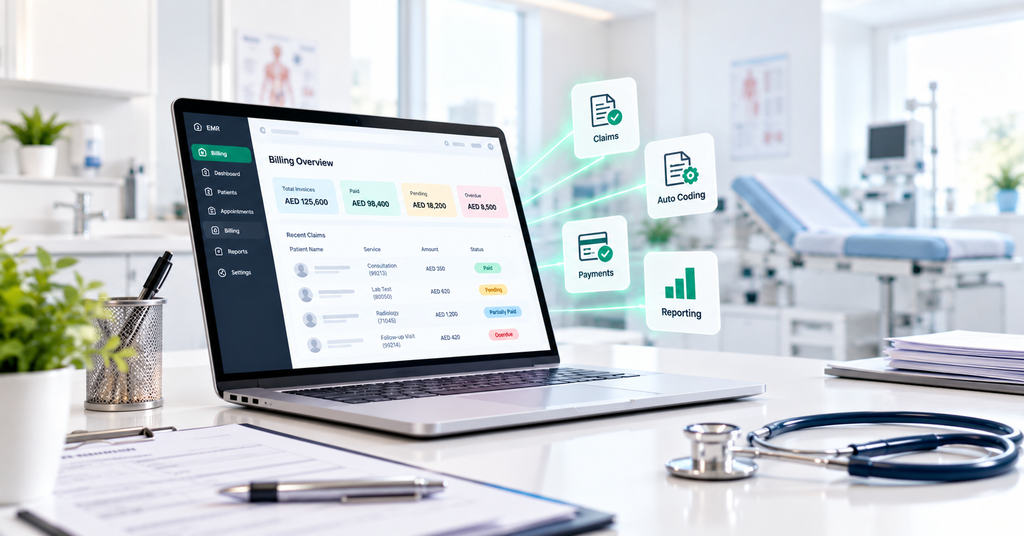
Traditional industry analysis frames revenue cycle management as a choice between paying medical billing companies in UAE or hiring internal staff. This binary framing ignores how modern healthcare technology operates in 2026.
THE THREE BILLING MODELS COMPARED
1. OUTSOURCED RCM AGENCY : High variable cost (4-9%), low control
2. MANUAL IN-HOUSE TEAM : High fixed cost (salaries), high control
3. EMR-NATIVE AUTOMATION : Low fixed cost (integrated), full control
A well-integrated, specialized EMR platform connects directly with regulatory clearinghouses like DHPO, eClaimLink, and Shafafiya. Rather than relying on manual claim entry or outsourcing the entire department, clinics can automate core billing tasks directly within the clinical workflow.
How EMR-Native Billing Changes the Financial Equation
When comparing automated EMR tools to traditional medical billing companies in UAE, embedding billing directly into clinician workflows drops the administrative burden dramatically:
- Automated Code Population: As doctors record patient consultations, diagnoses, and procedures, the system automatically translates clinical notes into corresponding ICD-10 and CPT codes.
- Real-Time Eligibility Verification: Front-desk staff verify insurance coverage, active co-pays, and deductible limits before the patient enters the consultation room, preventing eligibility-based rejections at the source.
- Direct DHPO/eClaimLink Transmission: Clean eClaims submit directly to regional health clearinghouses with a single click, eliminating external export routines or manual web portal re-entry.
- Automated Claim Scrubbing: Built-in validation rules detect missing pre-authorization numbers, mismatched gender-procedure codes, or invalid doctor license numbers before the claim leaves the system. To understand why these errors occur so frequently in manual workflows, explore our detailed analysis on the most common causes of claim rejection in UAE clinics.
AUTOMATED EMR CLAIM SCRUBBING WORKFLOW
Clinical Encounter
|
v
Auto-Populate ICD-10 / CPT
|
v
Real-Time Pre-Auth & Rule Validation
|
v
Immediate eClaimLink / DHPO Submission
Where Software Ends and Staff Expertise Begins
When replacing external medical billing companies in UAE with software, it is vital to remain realistic about the boundaries of automation. Complex clinical appeals, unique TPA disputes, and edge-case coverage denials will always require human judgment.
However, native EMR integration fundamentally alters staffing requirements. Instead of needing three full-time billing specialists to process claims manually, a clinic may only require a single cross-trained administrator to handle exceptional cases and monitor performance dashboards. To learn more about how regional frameworks operate, review our breakdown of the NABIDH, Riayati, and DHPO integration standards.
A Simple Framework for Deciding
No single billing model fits every medical practice in the UAE. Deciding whether to contract medical billing companies in UAE or manage claims in-house requires evaluating clinical volume, specialty mix, and existing internal expertise.
CLINIC DECISION MATRIX
CLINIC PROFILE | RECOMMENDED STRATEGY
High-volume hospital, | Hybrid / Outsourced RCM
complex multi-specialty | (Deep appeal capabilities required)
Steady polyclinic, | EMR-Native Billing + Internal Admin
single/multi-doctor | (Maximum margin & process control)
Scaling multi-branch, | EMR-Native Billing Center
growing revenue | (Replaces percentage fees at scale)
Scenario A: High Volume, Complex Specialty Mix, Zero Internal Staff
- Recommendation: Medical Billing Companies in UAE (or Hybrid Model)
- Rationale: If your facility handles complex surgical procedures, multi-stage hospitalizations, or high-risk specialty claims without any internal billing infrastructure, outsourcing can stabilize cash flow quickly. In this setup, paying medical billing companies in UAE an agency fee is often preferable to building an advanced billing department from scratch during an operational crisis.
Scenario B: Steady Volume, Outpatient Clinic, Capable EMR
- Recommendation: In-House Administrative Oversight + EMR-Native Automation
- Rationale: For primary care centers, dental practices, dermatology clinics, and outpatient polyclinics, an EMR with built-in DHPO connectivity handles up to 90% of routine claim processing automatically. Existing reception or practice management staff can review automated validation reports and submit clean eClaims without paying medical billing companies in UAE percentage fees or expanding headcount.
Scenario C: Scaling Multi-Branch Medical Center
- Recommendation: Centralized In-House Billing powered by EMR Automation
- Rationale: As clinic revenue scales past several hundred thousand dirhams per month, percentage-of-collection arrangements with medical billing companies in UAE become prohibitively expensive. Investing in a robust, multi-branch cloud EMR platform allows a lean, centralized internal team to process billing across all branches efficiently, capping operational software costs while protecting overall margins.
How Medic Handles Billing and DHPO Claims Natively
Medic by Freit.io was engineered specifically to solve the operational and compliance challenges faced by clinics operating across Dubai, Abu Dhabi, and the Northern Emirates. Rather than forcing practices to rely on costly medical billing companies in UAE or tedious manual data entry, Medic embeds insurance claims automation directly into standard clinical documentation workflows.
MEDIC EMR NATIVE BILLING CAPABILITIES
Integrated eClaimLink & DHPO Gateways
Automated ICD-10 & CPT Code Mapping
Real-Time Member Verification
One-Click Resubmission & Appeals
Direct DHPO, eClaimLink, and Regulatory Integration
Medic features native connections to the UAE’s primary health information exchanges and claim clearinghouses, including DHPO, eClaimLink, NABIDH, and Riayati. Practice staff can check patient policy limits, verify active insurance coverage, and confirm required co-payments in real time before consultations begin.
Automated Coding and Claim Validation
When physicians record diagnoses, clinical notes, and treatment plans in Medic, the system automatically populates the appropriate ICD-10-CM diagnostic and CPT procedural codes. Built-in claim scrubbing engines validate data integrity before submission—checking required pre-authorization codes, provider licensing details, and coverage rules to minimize first-pass rejections.
Rejection Tracking and Financial Analytics
When a TPA or health authority returns a claim rejection, Medic categorizes the refusal reason immediately within an intuitive dashboard. Administrative staff can correct missing fields and resubmit claims directly from the system, reducing turnaround times from weeks to hours. Integrated business intelligence reports track cost-to-collect ratios, rejection trends, and outstanding payor balances, providing clinic management with complete financial transparency.
Conclusion & Next Steps
Determining whether to hire medical billing companies in UAE or manage claims internally is not a simple binary decision. External medical billing companies in UAE provide immediate expertise but extract a growing percentage of top-line revenue as your business expands. Manual in-house billing keeps full control inside the practice but demands continuous payroll and training overhead.
For most UAE outpatient practices and polyclinics, adopting an EMR platform with native DHPO billing automation offers the most sustainable balance. By automating code mapping, scrubbing claims prior to submission, and simplifying rejection tracking, modern software allows clinics to maintain full financial control while keeping overhead low.
Ready to Optimize Your Revenue Cycle?
Discover how Medic by Freit.io can streamline your billing processes, reduce insurance claim rejections, and save your practice administrative costs.
- Book a Personal Demo: Request a Live Medic Demo
- Email Support: info@freit.io
- Direct Phone: +971 55 582 8493 / +971 50 136 4096
- Headquarters: Hi-Tech Office 101, Sharjah Research Technology and Innovation Park (SRTIP), Sharjah, UAE
Frequently Asked Questions (FAQ)
How much do medical billing companies in UAE charge?
Global industry benchmarks show that outsourced medical billing companies in UAE typically charge between 4% and 9% of net collected revenue, or a flat fee per claim. However, specific UAE market rates vary depending on clinical specialty, volume, and TPA complexity. Clinics should request detailed, written quotes from potential vendors to evaluate net costs against local reimbursement volumes.
Is in-house medical billing cheaper than outsourcing?
In-house billing replaces variable percentage fees with fixed payroll, health insurance, visa costs, and coding software fees. For low-to-moderate volume clinics, in-house manual billing can carry higher fixed costs than outsourcing. However, pairing internal administrative staff with automated EMR billing tools drastically reduces labor requirements, making in-house operations significantly cheaper at scale.
Can EMR software replace a medical billing company?
An EMR with native DHPO and eClaimLink connectivity automates repetitive tasks like code mapping, eligibility checks, claim scrubbing, and submission tracking. While software handles the vast majority of routine claim processing automatically, human oversight remains necessary to manage complex appeals, unique TPA negotiations, and clinical documentation queries.
What should a clinic look for in a contract with **medical billing companies in UAE?
Clinics evaluating third-party billing contracts should examine clauses regarding minimum monthly fees, setup charges, clearinghouse pass-through costs, and contract termination terms. Crucially, ensure the agreement defines whether percentage fees apply strictly to collected revenue or submitted claims, and verify who remains responsible for appealing rejected claims.
Does outsourcing medical billing reduce insurance claim rejections?
Outsourcing to an experienced billing agency can lower rejection rates if internal staff lack coding expertise. However, rejections often stem from incomplete clinical documentation or missing pre-authorizations created at the point of care. An integrated EMR that scrubs claims before submission solves root-cause errors directly within the clinical workflow.