
Choosing EMR software for a UAE clinic isn’t simply a matter of finding a system that stores patient records. The right platform needs to fit your regulatory environment, clinical workflows, insurance processes, reporting needs, and growth plans. Clinics comparing EMR software UAE should look closely at daily workflow support.
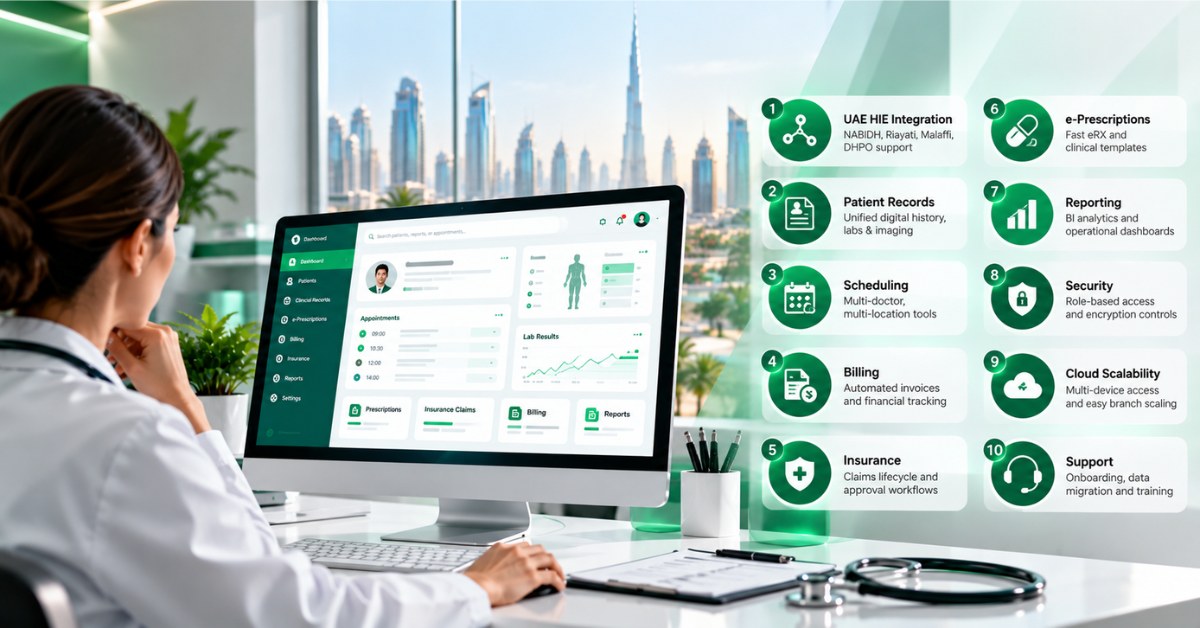
The 10 features below give clinic owners, medical directors, and healthcare managers a practical framework for evaluating EMR vendors before signing a contract.
Table of Contents
What Should You Look for in EMR Software for UAE Clinics?
Selecting a platform requires looking past generic feature lists. A suitable system for a UAE medical facility must seamlessly combine: A clear view of EMR software UAE helps practice managers plan upgrades. Keep these points in mind when reviewing EMR software UAE for your own situation.
- Compliance with local health authorities
- Clinical Records for streamlined patient care
- Operations including multi-doctor scheduling
- Revenue & Insurance workflows tailored to local payers and DHPO
- Security & Scalability to protect data and support multi-branch growth
1. UAE Health Information Exchange Integration
Does the EMR support the right UAE health exchange?
Regulatory compliance in the UAE is tied directly to regional Health Information Exchanges (HIEs). Depending on where your facility operates, your EMR must integrate seamlessly with specific platforms to ensure statutory data sharing. Staff training is central to any EMR software UAE rollout. Ask vendors how EMR software UAE handles appointment reminders and billing exports.
- NABIDH: Connects Dubai healthcare providers’ EMR systems to the exchange.
- Malaffi: The unified health information exchange platform for Abu Dhabi.
- Riayati / DHPO: Federal and Department of Health electronic health solutions and claims routing.
What should you ask the vendor?
- Which UAE HIEs do you actively support?
- Is the integration currently live and operational in other UAE clinics?
- Who handles conformance testing and technical updates when regulatory requirements change?
2. Complete Digital Patient Records
What should a complete patient record include?
An effective EMR shouldn’t merely store basic consultation notes. It must centralize the entire patient journey into a single pane of glass, bringing together:
- Medical history and vitals
- Allergies, vaccinations, and diagnoses
- Lab results, imaging, and treatment plans
- Prescriptions and follow-up data
Can clinical information and diagnostics stay connected?
Physicians need immediate access to a patient’s historical data without toggling between separate applications or hunting through paper archives. Integrated diagnostics ensure diagnostic reports feed directly into the active medical record. Reliable EMR software UAE depends on data security and local compliance. A clear view of EMR software UAE makes the next decision easier.
3. Appointment & Scheduling Management
Which scheduling capabilities matter?
Operational efficiency begins at the front desk. A strong EMR connects clinical schedules with front-office workflows. Look for: Many practices review EMR software UAE options before renewing their contracts.
- Multi-doctor and multi-day calendar views
- Recurring visits and automated rescheduling
- Slot blocking, availability management, and double-booking prevention
- Multi-location scheduling for growing medical groups
4. Billing & Revenue Management
Can clinical and financial workflows connect?
Treating billing as an isolated module creates friction and revenue leakage. Evaluate whether the platform natively links clinical encounters to financial transactions, supporting:
- Automated invoicing and flexible payment options (cash, card, insurance co-pays)
- Outstanding balance tracking and service packages
- Real-time financial reporting tied directly to clinical services rendered
5. Insurance & Claims Management
What should UAE clinics check?
Because a massive portion of private healthcare revenue in the UAE flows through insurance companies and third-party administrators (TPAs), your EMR must simplify not complicate the claims lifecycle. Evaluate whether it supports: Teams that document their EMR software UAE requirements avoid costly delays. Teams that understand EMR software UAE early avoid most avoidable delays.
- Automated pre-authorizations and insurance approvals
- Direct claim submissions and eRX integration
- Remittance tracking, rejection management, and DHPO compliance
6. e-Prescriptions & Clinical Workflows
Does the system reduce clinical administration?
Digitizing a prescription pad is not enough; the EMR should accelerate the entire clinical encounter. Look for: Compare EMR software UAE vendors on integration, support and reporting. Review EMR software UAE against your own requirements before you commit.
- 1-click digital prescriptions and structured treatment plans
- Rapid clinical templates tailored to specific medical specialties
- Direct connectivity with partner pharmacies to minimize patient waiting times
7. Reporting & Business Intelligence
Which reports should clinic managers expect?
Management needs actionable insights, not raw data dumps. Your EMR should function as a business intelligence tool capable of generating:
- Revenue breakdowns, cash flow trends, and service performance metrics
- Doctor productivity and utilization reports
- Insurance claim approval/rejection analytics
- Multi-branch operational performance summaries
8. Security & Access Controls
What security questions should you ask an EMR vendor?
Data governance in UAE healthcare is strictly regulated. While international frameworks like HIPAA provide a baseline for cloud architecture, they do not automatically guarantee local compliance. You must look for security controls tailored to regional standards, including: Good EMR software UAE setups keep front desk and clinical staff aligned.
- Robust data encryption (at rest and in transit)
- Granular role-based access controls and user permissions
- Comprehensive audit logs tracking every record view or edit
- Secure cloud backup and disaster recovery protocols
9. Cloud Accessibility & Scalability
Can the platform grow with your clinic?
A cloud-based architecture allows clinical and administrative staff to access records securely across multiple devices without requiring expensive, on-premise server infrastructure. Ensure the software can scale effortlessly when your clinic adds new practitioners, expands departments, or opens a new branch across the emirates. Before buying EMR software UAE, test it with real appointment and billing data.
10. Implementation, Training & Support
What should implementation include?
Even the most advanced software will fail if staff adoption is low or data migration is botched. A reliable vendor provides end-to-end onboarding support:
- Structured staff training programs
- Seamless historical data migration from legacy systems
- Ongoing technical support channels and proactive system updates
EMR Software UAE: A Practical Vendor Evaluation Checklist
You can use this summary checklist during vendor demos and software evaluations: Regular reviews of EMR software UAE reveal gaps that are easy to miss.
| Evaluation Area | What to Look For | Vendor Score (1–5) |
| 1. UAE HIE Integration | NABIDH, Riayati, Malaffi, DHPO support | [ ] |
| 2. Patient Records | Unified digital history, labs, & imaging | [ ] |
| 3. Scheduling | Multi-doctor, multi-location calendar tools | [ ] |
| 4. Billing | Automated invoices and financial tracking | [ ] |
| 5. Insurance | Claims lifecycle and approval workflows | [ ] |
| 6. e-Prescriptions | Fast eRX and clinical templates | [ ] |
| 7. Reporting | BI analytics and operational dashboards | [ ] |
| 8. Security | Role-based access and encryption controls | [ ] |
| 9. Cloud Scalability | Multi-device access and easy branch scaling | [ ] |
| 10. Support | Onboarding, data migration, and training | [ ] |
How Medic Compares Against These 10 Requirements
A UAE clinic should evaluate any EMR against strict local operational realities. Medic is built from the ground up to address these exact requirements, offering a unified cloud platform designed for modern medical practices. Clinic owners often underestimate how much EMR software UAE affects daily operations. Good planning around EMR software UAE saves time and cost later.
| Evaluation Area | What to Look For | Medic Capability |
| UAE Integrations | Relevant HIE connectivity | NABIDH, Riayati, DHPO supported |
| Patient Records | Complete digital record | Included |
| Scheduling | Multi-doctor / multi-day | Included |
| Billing | Invoicing & payments | Included |
| Insurance | Claims & approvals | Included |
| eRX | Digital prescriptions | Included |
| Analytics | Operational/financial reports | Included |
| Security | Access controls/encryption | Included |
| Cloud | Device/access flexibility | Included |
| Implementation | Training/data migration | Included |
Questions to Ask Before Signing an EMR Contract
- Which UAE health information exchanges (NABIDH, Riayati, Malaffi) do you actively support?
- Is the integration currently live and certified for operational use?
- Who handles regulatory updates when health authority standards change?
- How is patient data migrated from our legacy system or paper records?
- What is the typical implementation timeline from contract signing to launch?
- Is comprehensive staff training included in the onboarding package?
- What happens when our clinic opens another branch or adds new specialties?
- Can we easily export our clinical and financial data if needed?
- How are user permissions and role-based access restrictions managed?
- What local support channels and response times are guaranteed post-launch?
Ready to evaluate your clinic’s EMR requirements with a platform built for the UAE?
Book a Free Medic Demo or Speak with a Medic Specialist to review your workflows, compliance needs, and growth plans today. A simple checklist for EMR software UAE can prevent costly mistakes.