
NABIDH compliance is not a recommendation your clinic can choose to defer. It is a legal requirement governing every healthcare facility licensed by the Dubai Health Authority, and the consequences of falling short are immediate and operational. Imagine a routine Tuesday at a busy medical centre in Dubai Healthcare City. An unannounced DHA inspector arrives, requests proof of active health data integration, and the clinical director opens the practice management system to find no live data connection. The facility fails the audit on the spot. License renewal is frozen, and everything that took years to build is suddenly at risk.
This scenario happens more often than clinic owners expect. Most medical facility managers in Dubai know the name NABIDH. Far fewer understand precisely what the platform demands from their daily workflows, their software, and their staff, until an inspection forces the issue.
This guide covers everything your clinic needs to know: what NABIDH is, who it applies to, what happens without it, and how Medic by Freit.io makes full compliance a seamless, background process rather than an ongoing administrative burden.
Table of Contents
What Is NABIDH? Dubai’s Official Health Information Exchange Explained
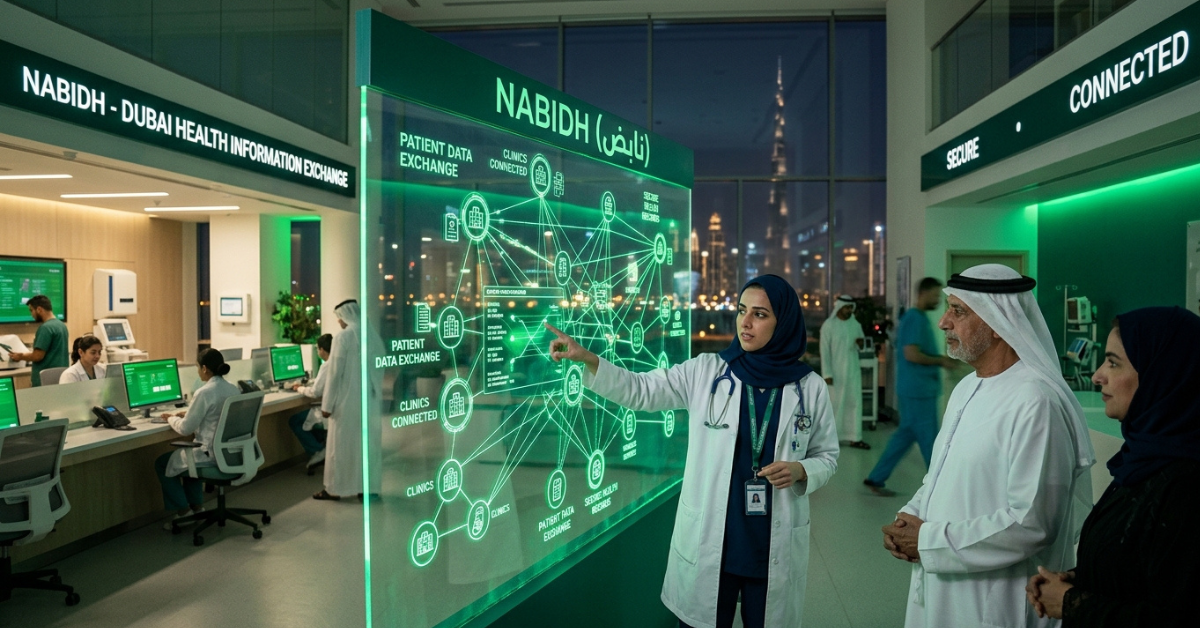
NABIDH stands for the National Backbone for Integrated Dubai Health. Launched and governed by the Dubai Health Authority, it is Dubai’s official Health Information Exchange (HIE), a secure centralised digital pipeline that links every public and private healthcare facility across the emirate into a single unified network.
The platform compiles data into a lifelong medical record for every patient registered in Dubai. When a patient walks into any DHA-licensed facility, their complete health history becomes accessible to the treating physician in real time, provided the clinic uses a compliant system. Equally, every consultation, prescription, lab result, and clinical note your team generates must be transmitted back to the central backbone automatically.
According to the Dubai Health Authority’s official announcement, NABIDH has now unified over 9.53 million patient records across more than 1,500 healthcare facilities, with 82% of Dubai’s medical workforce actively engaged in the system. These are not aspirational targets. They represent the operational standard your clinic is measured against during every DHA inspection.
What Data Must Your Clinic Transmit to NABIDH?
Your clinical team must be equipped to transmit the following data points in real time, in structured digital formats:
- Clinical progress notes and consultation records, capturing the details of every patient encounter in coded, searchable form.
- Electronic prescriptions and medication histories, ensuring every drug dispensed or ordered is traceable across the patient’s record.
- Laboratory test orders and structured diagnostic results, including values, reference ranges, and ordering physician details.
- Radiology reports and imaging interpretations, linked to the relevant episode of care.
- Discharge summaries and referral documentation, completing the continuity loop across providers.
How NABIDH Relates to Riayati and Malaffi
A common point of confusion for clinic managers is how NABIDH relates to other health information exchanges operating across the UAE. These are distinct systems managed by different regional authorities, and your compliance obligations depend entirely on where your facility is licensed.
| Platform | Governing Body | Applies To |
|---|---|---|
| NABIDH | Dubai Health Authority (DHA) | All DHA-licensed facilities in Dubai |
| Malaffi | Department of Health (DoH) | Healthcare providers in Abu Dhabi |
| Riayati | Ministry of Health and Prevention (MOHAP) | Facilities in the Northern Emirates |
If your facility holds a DHA licence, NABIDH is your primary legal obligation. While the three platforms share data to support continuity of care across the country, failing your Dubai integration cannot be offset by compliance with any other regional framework. For a detailed breakdown of how Medic handles both NABIDH and Riayati integration for clinics operating across multiple emirates, visit the Medic NABIDH integration page.
Is NABIDH Compliance Mandatory for Your Clinic? The Legal Framework
The short answer is yes, without exception. NABIDH compliance is mandated under Dubai Health Data Law No. 11 of 2018 and Federal Law No. 2 of 2019, as confirmed by the Dubai Health Authority’s regulatory framework. The mandate applies to every licensed healthcare facility regardless of size, patient volume, or specialty.
There are no exemptions for small practices. A solo general practitioner in a neighbourhood clinic carries the exact same integration obligations as a 200-bed multi-specialty hospital in Dubai Healthcare City. The DHA does not offer size-based grace periods or interim manual alternatives.
Critical note for clinic owners: Being fully licensed by the DHA does NOT mean you are automatically NABIDH compliant. Facility registration grants you the right to operate. NABIDH integration is a separate technical process that must be completed independently, even if your licence was issued recently.
The NABIDH Onboarding Timeline
Because the technical integration process involves multiple stages of testing and validation with the DHA, clinics cannot treat this as a last-minute task before an audit or licence renewal. The process typically takes 6 to 8 weeks from software activation to receiving your official NABIDH facility code.
| Phase | What Happens |
|---|---|
| Phase 1: Vendor Selection | Choose a DHA-certified EMR partner |
| Phase 2: Technical Setup | Configure software and map clinical data fields |
| Phase 3: DHA Connectivity | Establish secure connection to the central network |
| Phase 4: Conformance Testing | Pass mandatory DHA data validation rounds |
| Phase 5: Facility Code Issued | Receive official NABIDH identification code |
Estimated total duration: 6 to 8 weeks from software activation.
This timeline reinforces why proactive planning matters. A clinic that waits until 30 days before licence renewal to begin the integration process will not complete it in time.
What Happens If Your Dubai Clinic Is Not NABIDH Compliant?
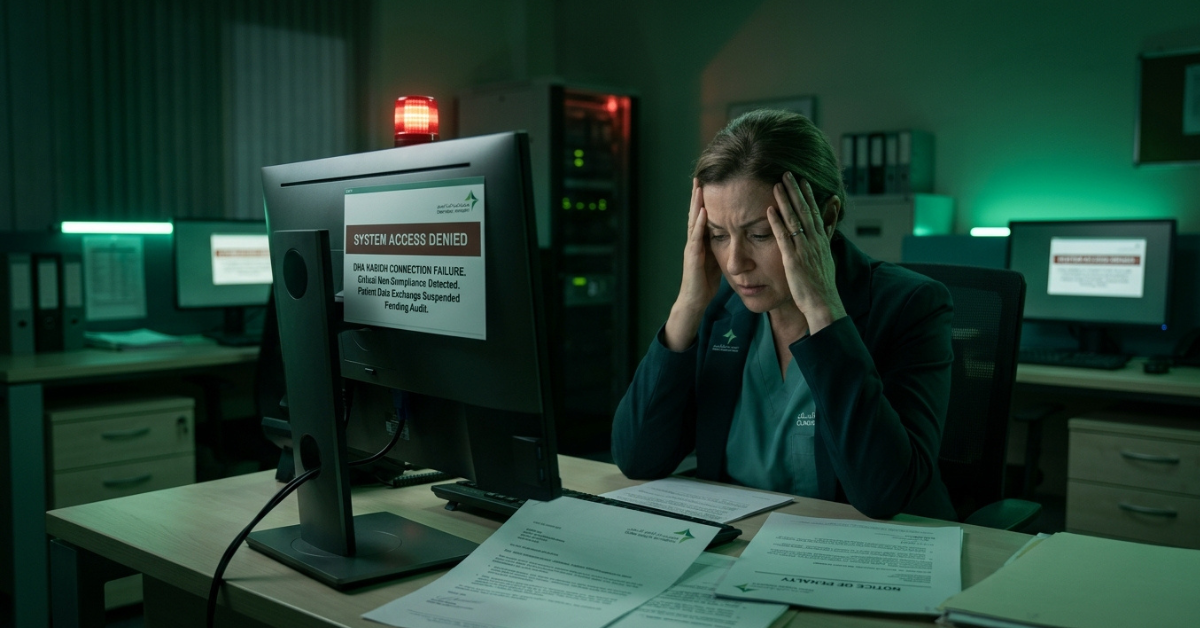
Operating without an active, verified NABIDH connection creates a cascade of operational and regulatory consequences. The DHA has embedded health data exchange compliance into its core enforcement frameworks, and the effects of non-compliance are felt immediately rather than at some distant review date.
Step 1: Immediate DHA Audit Failure
During any standard or unannounced DHA inspection, compliance officers will verify your live connection to the health information exchange. If your system cannot demonstrate active, real-time data synchronisation, your facility is flagged for non-compliance on the spot.
Step 2: Licence Renewal Blockages
A flagged audit directly threatens your commercial viability. The DHA requires confirmed proof of active NABIDH integration before approving annual facility licence renewals. Non-existent or broken integration places your renewal application on conditional hold, creating bureaucratic delays that can disrupt your ability to legally continue operating.
Warning: A licence renewal held on compliance grounds does not simply delay paperwork. It can prevent your facility from legally treating patients until the condition is resolved, affecting staff, patients, and revenue simultaneously.
Step 3: Inability to Access Critical Patient Histories
Beyond administrative penalties, non-compliant clinics face severe clinical limitations. Without an active connection to the central network, your physicians cannot view a patient’s external medical history, prior drug allergies, recent laboratory trends, or pre-existing conditions documented by other Dubai providers. Treatment decisions made without this context carry elevated patient safety risks.
Step 4: Compounded Administrative Burden
Clinics using non-integrated software often attempt to compensate through manual documentation, scanning printed records, or copying data between disconnected systems. This approach significantly increases clerical errors, drives up operational overhead, and exhausts administrative and nursing staff who could otherwise be supporting clinical workflows.
Step 5: Patient Trust and Retention Losses
Patients in Dubai increasingly expect their medical histories to follow them seamlessly between providers. When a patient realises your clinic cannot view recent lab work from a nearby hospital, or that their Medic prescription is not appearing at the pharmacy because your system is not connected, confidence erodes. Non-compliant clinics consistently lose patients to modern, integrated competitors where care journeys remain uninterrupted.
What NABIDH Compliance Actually Requires: The Practical Checklist
Understanding your obligations in practical terms is essential for clinic managers, operations heads, and practice owners. Compliance is not a single action but a set of ongoing operational and technical requirements.
NABIDH Compliance Readiness Checklist
- [ ] Your clinic operates on a DHA-approved, NABIDH-certified EMR platform
- [ ] Clinical data is entered in structured, coded formats using ICD-10 diagnosis codes and CPT procedure codes
- [ ] Your facility has received an official NABIDH Facility Code from the DHA
- [ ] Patient data is transmitted to the NABIDH backbone in real time at every consultation, not in batch uploads
- [ ] All clinical and administrative staff have completed NABIDH protocol training
- [ ] Your EMR vendor manages the technical maintenance of the data connection, not your internal team
- [ ] Your system supports HL7 and FHIR data communication standards natively
- [ ] Insurance claims are submitted through DHPO integration within the same platform
Important: NABIDH does not accept manual data uploads, spreadsheet exports, or scanned documents as valid forms of compliance. Automated, real-time transmission through a certified system is the only accepted method.
The Software Criteria That Determine Compliance Success
The quality of your EMR platform determines whether data compliance runs invisibly in the background or becomes a constant source of operational friction. When evaluating software options for your Dubai clinic, prioritise these criteria:
DHA Vendor Certification. The system must appear on the DHA’s verified vendor roster. Without current DHA certification, the software cannot secure your official facility code, regardless of its other features.
Native HL7 and FHIR Architecture. The platform must natively support the international healthcare data communication standards that allow clinical inputs to be packaged in the exact encrypted format the NABIDH backbone requires.
Enforced Structured Data Entry. Systems that allow free-text clinical notes without linking to standardised medical terminologies will fail DHA validation checks. The software must build ICD-10, CPT, and medication coding into the standard clinical workflow.
Automated Vendor-Managed Connectivity. Your clinical team should focus on patient outcomes, not debugging data transmission failures. The technical configuration, testing, and ongoing maintenance of the NABIDH connection must be handled entirely by your software partner.
Cross-Platform UAE Capability. A robust Dubai clinic system should also support Riayati for patients from the Northern Emirates and integrate natively with DHPO for insurance eligibility and e-claims processing.
Is your clinic approaching a DHA licence renewal or audit? Book a free compliance consultation with Medic by Freit and find out exactly where your integration stands.
How Medic by Freit Makes NABIDH Compliance Effortless
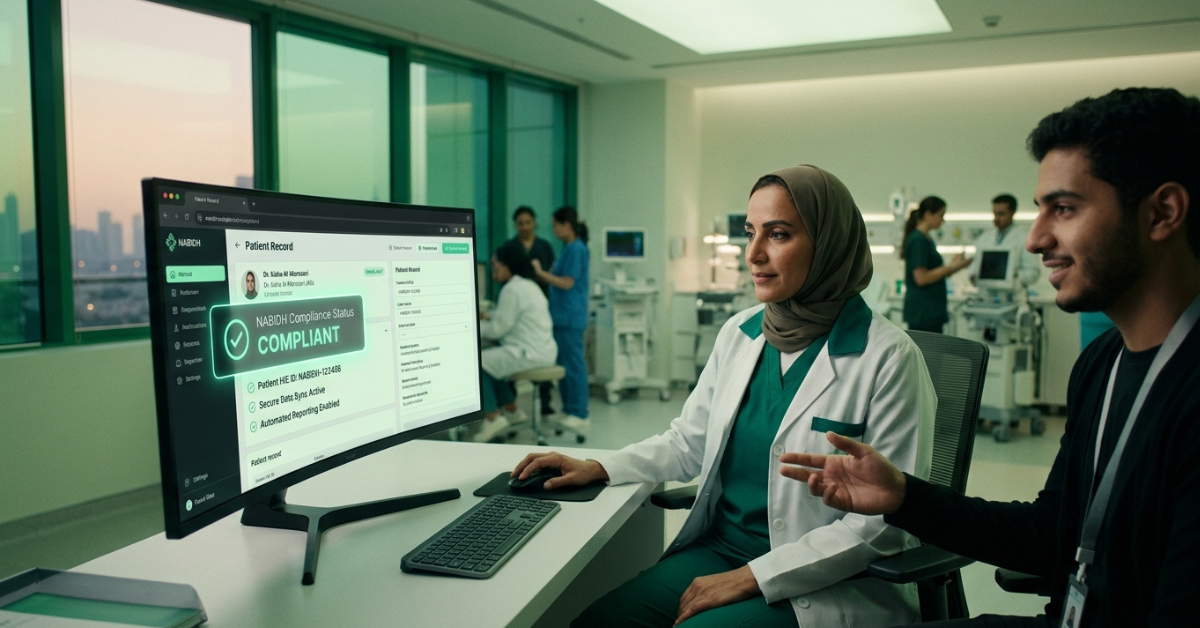
Medic by Freit.io was not designed as a generic international EMR with compliance features bolted on as an afterthought. It was built from the ground up for the UAE regulatory environment, with NABIDH, Riayati, and DHPO workflows embedded directly into the core platform interface. Every consultation your doctors complete, every prescription they sign, and every lab result they record is automatically structured and transmitted in the background without any additional steps from your clinical team.
What Medic Delivers for NABIDH Compliance
DHA-Approved and Fully Certified. Medic is a verified DHA-certified platform, giving clinic owners immediate confidence that their software satisfies the strictest local regulations from day one of operation.
Turnkey Technical Onboarding. The dedicated Medic UAE implementation team manages the complete NABIDH onboarding process on your behalf. This includes coordinating directly with DHA technical teams, conducting all required conformance testing, and guiding your facility through to official facility code issuance without placing the IT burden on your staff.
Unified UAE Health Data Network. Medic provides built-in integration for NABIDH, Riayati, and the DHPO insurance portal, allowing clinic managers to handle patient records, regional compliance, and insurance claims from a single unified dashboard rather than switching between disconnected systems.
Real-Time Background Submissions. When a consultation is completed or a prescription is signed within Medic, the system automatically structures the clinical data and transmits it to the NABIDH backbone. There is no manual exporting, delayed uploading, or separate portal navigation required.
Inspection-Ready Audit Reports. When a DHA inspector requests documentation of data transmission activity, Medic provides clear, instantaneous proof of successful data exchanges, making audits straightforward and stress-free for your operations team.
Proven Track Record Across the UAE. Medic is trusted by over 50 clinics across Dubai, Sharjah, Abu Dhabi, and the Northern Emirates, supporting diverse specialties from dental and dermatology practices to multi-specialty family medical centres. You can learn more about the team and mission behind the platform on the Medic About page.
Frequently Asked Questions
What does NABIDH stand for and who governs it?
NABIDH stands for the National Backbone for Integrated Dubai Health. It is governed and managed by the Dubai Health Authority (DHA) and serves as Dubai’s official Health Information Exchange platform. The system securely links all public and private DHA-licensed healthcare facilities across the emirate, enabling real-time access to unified patient medical histories. According to the DHA’s official records, NABIDH has connected more than 1,500 healthcare facilities and unified over 9.53 million patient records to date. Participation is a mandatory legal requirement for maintaining a medical facility licence in Dubai.
Is NABIDH the same as Riayati or Malaffi?
No. These are three distinct platforms managed by different regulatory bodies across the UAE. NABIDH is governed by the DHA and applies specifically to healthcare providers licensed in Dubai. Malaffi is managed by the Department of Health (DoH) and covers Abu Dhabi facilities. Riayati is a federal initiative under MOHAP covering the Northern Emirates. While the platforms share data to support national continuity of care, a DHA-licensed clinic in Dubai must specifically achieve and maintain NABIDH compliance. Compliance with Riayati or Malaffi does not satisfy DHA requirements.
How long does NABIDH onboarding take?
Once a clinic deploys a certified platform and begins live operations, the formal onboarding and conformance testing phase with the DHA typically spans 6 to 8 weeks. This timeframe covers system registration, scheduling dedicated testing sessions with the DHA integration team, completing mandatory data validation rounds, and receiving the official facility code. Practice managers should begin the process several months before any scheduled DHA audit or licence renewal to avoid operational disruption. Medic’s onboarding team manages the entire process, significantly reducing the administrative burden on clinic staff.
Can I use international software and connect it to NABIDH separately?
No. The DHA does not permit clinics to use unapproved software and attempt to attach a separate NABIDH connection externally. The EMR system itself must be natively certified by the DHA and must support HL7 and FHIR data communication standards internally. Attempting to retrofit an uncertified system with a third-party NABIDH connector introduces significant technical risk, ongoing maintenance costs, and the likelihood of failing DHA conformance testing. Selecting a purpose-built, pre-certified platform like Medic eliminates these risks entirely.
Does NABIDH compliance apply to small or single-doctor clinics?
Yes. The Dubai Health Authority mandates NABIDH compliance for all licensed healthcare facilities regardless of their scale, patient volume, or medical specialty. A solo general practitioner operating a single-room clinic holds the exact same data integration obligations as a large multi-specialty hospital. The DHA applies uniform audit and renewal standards across all facility types. Implementing a compliant EMR system from the very first day of operation is the most cost-effective and risk-free approach for any new clinic in Dubai.
What is a NABIDH Facility Code and how do I get one?
A NABIDH Facility Code is a unique identifier issued by the DHA only after your clinic’s EMR system has successfully completed conformance testing, demonstrating that it can accurately send and receive encrypted patient files in the correct structured format. The code confirms your facility is officially listed as compliant on the NABIDH network. To obtain it, your software partner coordinates the testing process with the DHA technical team on your behalf. Medic by Freit manages this process entirely for client clinics, from initial registration through to code issuance.
What data must my clinic transmit to NABIDH at every consultation?
Every patient encounter must generate structured, coded clinical data that is transmitted to the NABIDH backbone in real time. This includes consultation notes linked to ICD-10 diagnosis codes, electronic prescriptions with medication details and dispensing records, laboratory test orders and results in structured formats, imaging reports, and referral or discharge documentation. Free-text narrative notes and scanned PDF documents are not accepted by the DHA’s validation systems. Your EMR platform must enforce structured data entry during every clinical workflow to ensure successful transmission.
What are the consequences of failing a DHA NABIDH audit?
Failing a NABIDH compliance audit results in your facility being flagged for non-compliance, which directly impacts your annual licence renewal application. The DHA places renewal applications on conditional hold until active, verified integration is confirmed, which can legally prevent your clinic from continuing to operate. Beyond licensing, non-compliant facilities cannot access the unified patient histories available through the NABIDH network, forcing clinical staff to make treatment decisions without complete patient context. This introduces both patient safety risks and reputational damage that drives patient attrition toward compliant competitors.
How does Medic handle the NABIDH connection technically?
Medic structures all clinical data entered through the platform into HL7-compliant formats and transmits it to the NABIDH backbone automatically at the point of care. There is no manual export step, no separate portal login, and no batch upload process required from your clinical or administrative team. The Medic technical team manages the configuration, maintenance, and ongoing monitoring of the data connection, while the platform’s built-in validation checks ensure that each data transmission meets DHA standards before it is submitted. If transmission errors occur, the system flags them immediately rather than allowing them to accumulate undetected.
Closing Note
The digital infrastructure of Dubai’s healthcare sector is no longer optional architecture for forward-thinking facilities. It is the operating environment every clinic must function within, governed by clear legal mandates and enforced through regular inspections. NABIDH compliance sits at the centre of that environment, determining whether your clinic can renew its licence, access complete patient histories, and deliver the standard of care that Dubai’s patients increasingly expect.
Treating compliance as a checkbox to manage before a renewal deadline is a strategy that consistently results in disruption, penalties, and avoidable cost. The only approach that protects your clinic long-term is deploying a platform where NABIDH compliance happens automatically, invisibly, and correctly on every single patient encounter.
Medic by Freit.io was built for exactly this environment. Trusted by over 50 UAE clinics and certified by the DHA, it transforms regulatory compliance from a recurring operational headache into a silent, reliable feature of daily clinical practice. Contact the Medic team today to speak with a UAE-based compliance specialist, or book your free demo to see full NABIDH compliance in action from day one.
Disclaimer: This blog is produced for informational and educational purposes only. It does not constitute legal, regulatory, or compliance advice. Requirements under NABIDH, DHA, MOHAP, and other UAE healthcare authorities are subject to change. Clinic owners and managers should consult directly with the relevant regulatory authority or a qualified compliance specialist for guidance specific to their facility type, licence category, and operational circumstances.